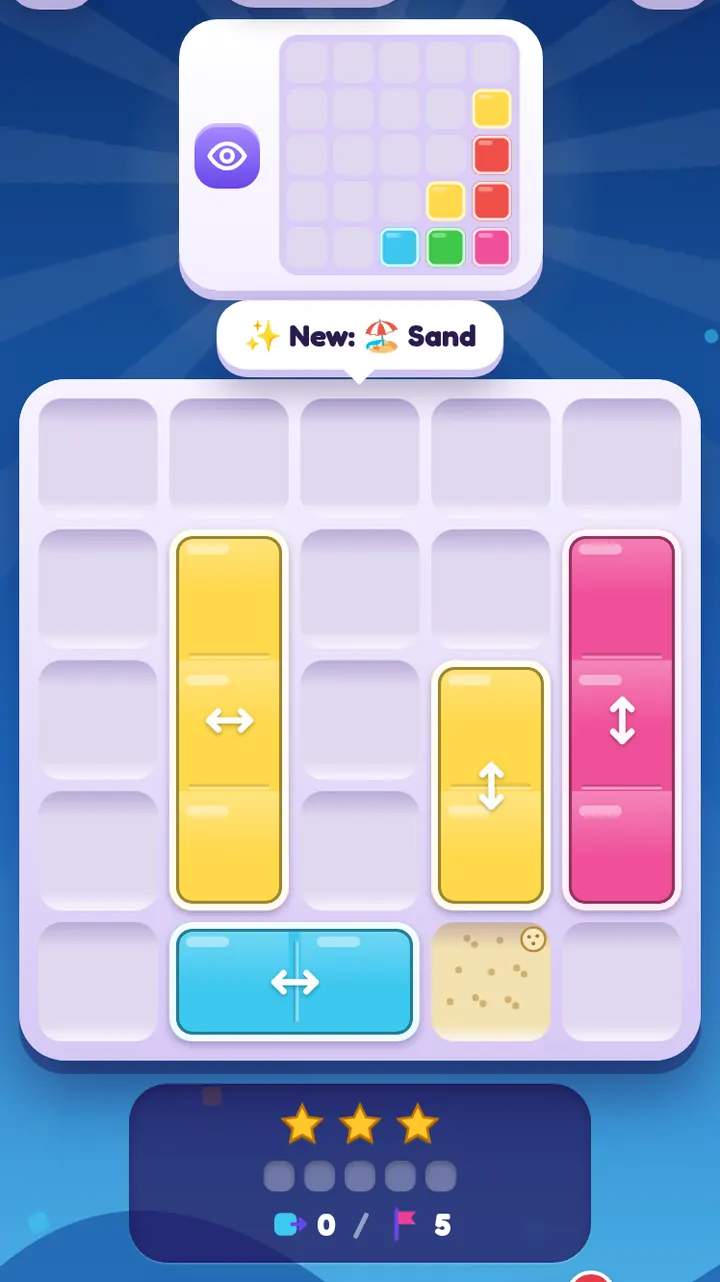
At level 52, sandy cells with small grains start to appear on the board. Sand is a gentle brake. A pane gliding along its rail stops when it slides onto more sand than it was on before.
The rule, exactly
As a pane glides, the game counts how many of its cells are on sand. If a step makes that number bigger, the pane moves onto the sand and stops there.
So:
- A pane that slides onto a sand cell stops on it.
- A pane that starts on sand and slides off it keeps going, because the count goes down, not up.
- A long pane already partly on sand stops when another of its cells reaches a new sand cell.
All the usual stops still apply: the edge, stone pillars, glass on the same kind of rail, and sticking on new colour. Sand is simply one more reason to stop. Glass on sand mixes colours normally.
How sand changes puzzles
Sand gives you stopping points without needing a crossing pane. On earlier boards, stopping a pane in the middle of a row usually meant moving another pane into its way first. With sand, the stopper is already built into the board.
That can make a level shorter, but it can also get in the way. A pane that needs to reach the far edge cannot glide across sand in a single swipe: it stops on the sand, and then a second swipe in the same direction carries it on, because sliding off sand never stops it.
Tip. Two swipes in the same direction are a normal move pattern on sand levels. The first stops on the sand, the second slides on to the next stop.
How to plan with sand
- Find the sand cells and note which rails pass through them.
- Treat each sand cell as a stopping point for every pane that can reach it, in both directions.
- Count swipes honestly. If a pane has to cross sand to reach its target, that is at least two swipes unless something else changes.
- Look for sand right at the target. If the picture needs a pane to end on a sand cell, it is probably a one-swipe move.
A quick example
A cyan pane sits at the left of a row, with one sand cell in the middle. The picture wants it at the right edge. The first swipe right stops it on the sand. The second swipe right slides it off and on to the edge. If par for the level seems one higher than you expected, a sand cell on a pane's route is a common reason.
Sand and ice together
Ice cancels sticking, so it makes glass slide further. Sand adds stops, so it makes glass slide less. When a level has both, read the board in two passes: first cross out the stoppers that sit on ice, then add the stops that sand creates.
Where sand comes from
Sand is the 6th of the nine special kinds taught in Levels mode, after locked glass (12), two-colour pictures (18), stone pillars (25), gems (33) and ice (42). It is followed by one-way glass (64), frosted glass (78) and mystery pictures (95). Each new kind gets its own teach level with a short tip and a slightly lower par, then returns throughout the following chapters.
Why a puzzle game needs brakes
Puzzles are interesting when you have to plan, and planning needs reliable rules. Sand is perfectly predictable: you can always see it, and its rule never changes. That makes it a fair way to add new stopping points, and new ideas, without adding luck.
Play from level 52 on the level map.